
Executive summary
- Keep historical evidence intact. A changed environment can limit its applicability without making the original observation false.
- Reuse procedures and context only after reviewing the assumptions they depend on. When those dependencies are unknown, a full rerun is the conservative baseline.
- Measure first use, repeat use and transfer to another environment separately, including preparation, diagnosis, review and maintenance.
01A historical pass is not a current assessment
A test receipt records an observation under particular conditions. If the client profile, certificate, NPS policy or application changes afterward, that receipt still describes what happened. The question is whether it supports the decision now being made. Deleting the old result loses useful history. Treating it as perpetually current loses the connection between evidence and configuration.
For a network-authentication assessment, the relevant state spans several owners. Endpoint teams manage Windows builds and profiles. Network teams manage access infrastructure and policies. Identity teams may manage certificate enrollment and mapping. Application teams define the operation that must continue. A change in one area can alter the meaning of another team’s evidence.
The October 2026 Windows change is a concrete reminder that an update can change effective behavior even when a local registry value is absent. Applicability depends on the documented conditions, including Credential Guard state. An inventory of explicit settings alone can miss a changed default. [1]
A useful maintenance process records both explicit configuration and the assumptions used to interpret it. It then asks whether those premises still hold for the next change. That review should be visible, rather than hidden inside a label that says the environment is already understood.
02Record what each conclusion depends on
Start with the acceptance claims and work backward. An authentication conclusion may depend on identity, selected profile, trust configuration, NPS policy and the state of the infrastructure that processed the request. An application conclusion additionally depends on the actual route, service behavior and freshness of the operation.
Not every inventory field deserves equal weight. A field belongs in the applicability record when a plausible change to it could alter the criterion or the interpretation of evidence. Record why it matters. This gives reviewers a basis for challenging an overly broad dependency list as well as a dangerously incomplete one.
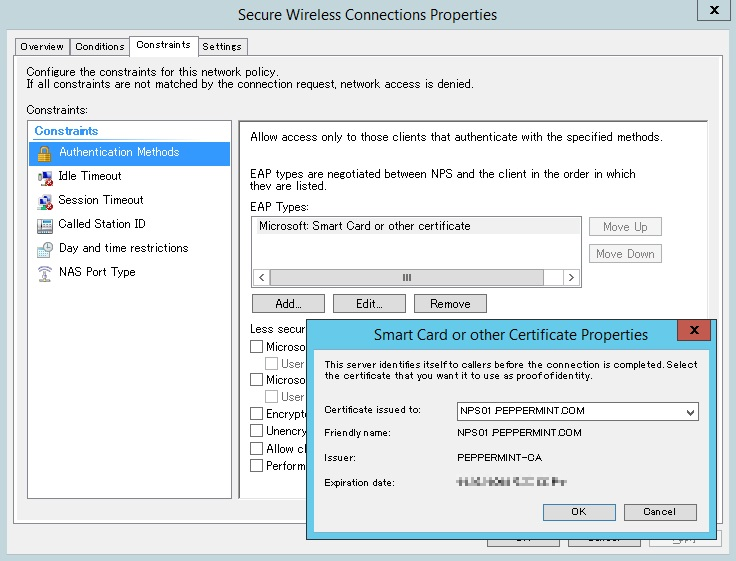
Windows-specific validation behavior makes this practical rather than abstract. The client OS and profile can determine how a server certificate is trusted. Certificate purpose and identity requirements also affect the exchange. A prior certificate-authentication result should therefore not be assumed to apply after an unreviewed profile or certificate change. [2] [3]
Use stable references to configuration snapshots and procedures where available. If a component cannot be captured reliably, mark that limitation and identify the owner who can confirm its state. A detailed diagram is not evidence that every represented dependency has actually been observed.
| Change | Why it matters | Review question |
|---|---|---|
| Client build or effective default | Authentication behavior may differ | Does the documented behavior still match this configuration? |
| Profile, identity or certificate | The attempted method or trust decision may change | Is the same approved identity and validation path exercised? |
| NPS policy or access infrastructure | A different decision or segment may be selected | Does the request match the intended policy and path? |
| Route, DNS or application | Successful access may reach different behavior | Does the required fresh operation still test the intended dependency? |
03Review applicability before reusing evidence
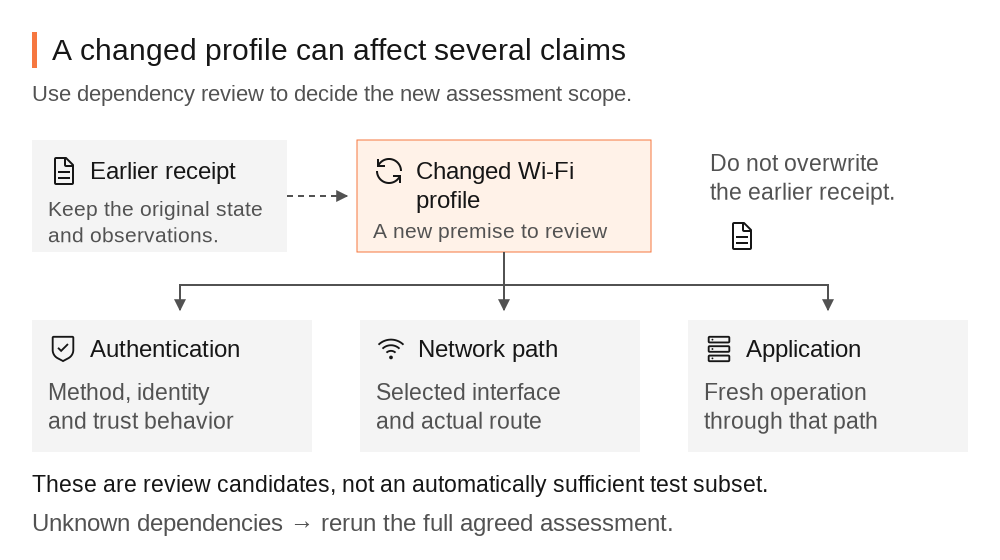
For each new assessment, compare the recorded state with the current candidate and identify changed or unknown premises. Then separate three decisions: whether an earlier receipt is relevant background, whether its procedure can be reused, and whether a new execution is required. Reusing a procedure does not mean reusing its previous outcome.
When the dependency relationship is clear, a reviewer may propose a narrower recheck. That is a hypothesis about sufficient coverage and needs justification. If the relationship is uncertain, repeat the full agreed assessment rather than presenting a guessed subset as complete. Full rerun remains the conservative baseline against which a selective approach should be evaluated.
For example, a new application operation may leave the authentication procedure unchanged while requiring new application evidence. A changed Wi-Fi profile may affect both the authentication attempt and the route used afterward. These are reasoning examples, not a universal retesting rule. The environment and acceptance criteria determine the required scope.
Preserve a link from the new decision to the older evidence, the changed premise and the new observations. This makes it possible to reconstruct why a reviewer trusted some prior context and requested additional work elsewhere.
04Distinguish reusable structure from environment-specific work
A report format, evidence schema or procedure outline may transfer well while the practical setup remains highly specific. Identity provisioning, profile delivery, policy isolation, collector permissions, event correlation and application transactions can all require adaptation. Calling the whole workflow reusable can conceal this work.
The NPS documentation and troubleshooting guidance describe useful component roles and observations, but they do not establish a universal correlation mechanism for a particular organization. Reviewers still need to connect client and server evidence to the correct identity and path. Differences in log access, retention or time synchronization can change the work required. [4] [5]
Keep a record of what transferred unchanged, what was adapted and what had to be rebuilt. Record the reason for each adaptation. The distinction helps separate a method with a stable core from a set of bespoke assessments that merely share a report template.
Apply the same discipline to broader support claims. Success on one Windows/NPS Wi-Fi path does not establish support for wired access, VPNs or another policy platform. Each expansion introduces a new applicability and execution question. Reusable concepts are valuable, but they are not evidence of implemented coverage.
05Measure total effort across repeated use
The business value of evidence maintenance depends on the entire assessment, not only the time required to run checks. Count environment preparation, procedure authoring, collection, investigation, review, recovery and ongoing maintenance. Include failed attempts and manual interventions. Otherwise, an apparently fast repeat may depend on uncounted expert work.
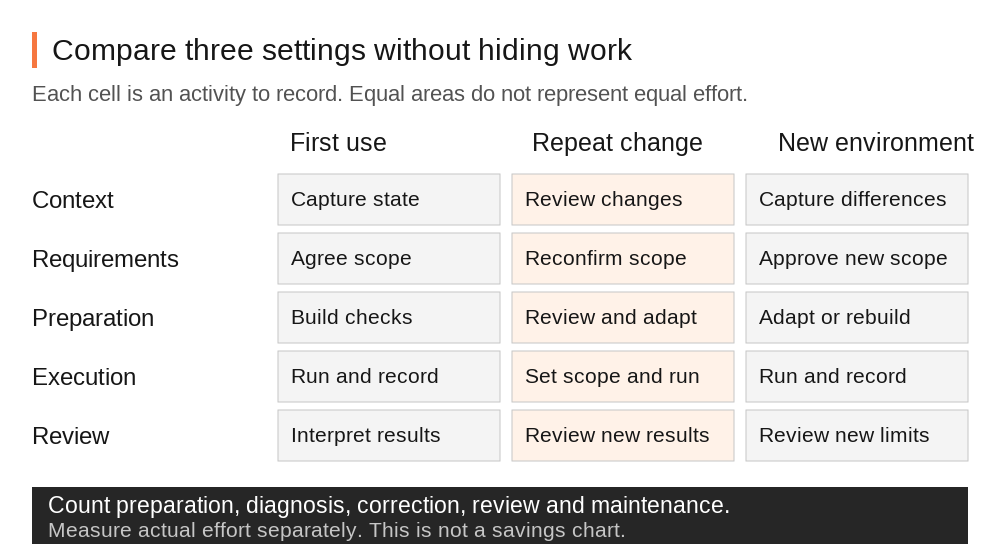
Evaluate three situations separately. First use captures setup and learning. A later change in the same environment tests whether context and procedures remain useful. Transfer to a second environment tests whether the approach reduces work beyond the original setup. Combining them into one average hides the most important differences.
Use a fair comparison. The baseline should be a capable engineer using native diagnostics, scripts and available coding assistance, with the same acceptance criteria and evidence requirements. Compare the quality of conclusions as well as effort. A faster method that misses an incorrect path or unexplained rejection has not delivered the same assessment.
Do not infer savings from fewer steps in a diagram. Measure elapsed time and active engineering effort separately, identify who performed the work, and preserve the boundaries of the comparison. Repeat assessments may become easier, but the amount and reliability of that improvement remain empirical questions.
06Publish findings that show what changed
A useful research update should identify the question, configuration, procedure, observations and limitations. If an experiment improves a method, explain which failure mode it addresses and which evidence supports the improvement. A sequence of progress announcements without reproducible details will not help an operator decide whether the work applies to their environment.
Keep sourced analysis, lab studies and customer results distinct. Sourced analysis can explain a documented mechanism and propose a test. A lab study should expose enough procedure and environment detail for independent scrutiny, including unsuccessful or inconclusive cases. A customer result needs permission, a defined deployment scope and evidence from that setting. One category cannot substitute for another.
The companion reassessment worksheet records changed premises, reuse decisions, required execution and total effort. Its purpose is to make the next assessment easier to inspect, not to certify that a previous pass remains valid indefinitely. The long-term research question is whether maintained environmental understanding can reduce work while preserving the quality and scope of the evidence. That claim should be earned through repeated observations.
References
- Microsoft: Upcoming changes to NTLMv1-derived credentials
Documents the conditional October 2026 default change, Audit and Enforce behavior, and events 4024 and 4025.
- Microsoft: EAP changes in Windows 11
Windows 11-specific server-certificate validation behavior takes precedence over older general guidance.
- Microsoft: Certificate requirements for PEAP and EAP
Describes distinct server and client certificate requirements, including purpose and identity checks.
- Microsoft: Network Policy Server overview
Establishes the role of NPS and RADIUS clients in network-access authentication and authorization.
- Microsoft: Troubleshoot 802.1X authentication
Documents NPS acceptance/rejection events and client-side wireless, wired and certificate diagnostics.
Sources reviewed November 7, 2026. This report presents sourced analysis and proposed engineering practice, not original experimental results.